
Portable Appliance Testing (PAT) is an important part of managing electrical equipment in many workplaces. For businesses responsible for large numbers of electrical appliances across multiple customers, sites or locations, keeping testing records up to date can quickly become a significant administrative task.
A missed PAT testing date does not automatically result in a fine or penalty. However, an overdue test can leave a gap in the records that demonstrate how electrical equipment is being maintained and managed.
That gap can become important if a customer asks to see compliance records, an auditor reviews a site, an insurer requests evidence, or an electrical incident occurs.
For businesses responsible for maintaining equipment on behalf of customers, the issue is therefore not simply whether a particular appliance has been tested. It is also whether the business can demonstrate that the appropriate checks were planned, carried out and recorded at the required intervals.
What Are the Consequences of Missing a PAT Testing Date?
The consequences of an overdue PAT test will depend on the circumstances, the equipment involved, contractual requirements and the applicable insurance and health and safety arrangements.
However, there are several areas where a missed testing date can create problems.
Contract and Compliance Requirements
For many service companies, electrical testing is carried out as part of a wider maintenance contract. The contract may specify testing frequencies, reporting requirements or particular compliance standards that the contractor is expected to maintain.
This means a missed PAT testing date can potentially become a contract management issue even when there has been no electrical failure or safety incident.
A client may request evidence that scheduled maintenance has been completed as part of a routine review. If the records show that an appliance was due for testing but the work was not completed on time, the customer may ask why the deadline was missed and what action was taken to correct it.
For contracts where compliance forms part of service-level agreements or performance measures, maintaining accurate and current records is particularly important.
Insurance and Evidence of Maintenance
There is no single rule that says a missed PAT test automatically invalidates commercial insurance. Insurance policies differ, and businesses should always refer to their own policy wording and speak to their insurer or broker where necessary.
However, maintaining appropriate records of electrical inspection and maintenance can be important when demonstrating that reasonable steps have been taken to manage workplace risks.
If an electrical incident occurs, being able to produce a clear history of inspections, testing and remedial work can help demonstrate how the equipment has been managed.
A missing or incomplete record can make that process more difficult.
Insurance providers may also request information about maintenance and compliance arrangements during underwriting or renewal. Keeping accurate records throughout the year is therefore preferable to trying to reconstruct them when a question is raised.
Audits and Client Compliance Checks
For many businesses, the most likely consequence of an overdue PAT test is not regulatory enforcement but a routine client or internal compliance check.
Large organisations, facilities management companies, landlords and other commercial customers may have their own supplier compliance procedures. Contractors can be asked to provide evidence that scheduled maintenance and testing has been completed.
If a customer asks for the PAT records for a particular site or appliance, the business needs to be able to locate the information quickly.
A complete record should make it possible to establish what equipment was tested, when it was tested, what the result was and whether any remedial work was required.
An incomplete register or unexplained gap can create additional questions and administration.
PAT Testing and Workplace Equipment
Businesses have responsibilities for ensuring that work equipment is maintained and remains safe to use. The requirements that apply will depend on the type of equipment, how it is used and the circumstances in which it is being operated.
The Provision and Use of Work Equipment Regulations 1998 (PUWER), for example, include requirements concerning the suitability, maintenance and inspection of work equipment where applicable.
PAT testing can form part of a business’s wider electrical equipment maintenance and inspection arrangements, but there is no universal legal requirement for every electrical appliance to receive a PAT test at a fixed interval.
The appropriate approach depends on the equipment, environment, risk and the manufacturer’s or other relevant guidance.
This makes good record keeping particularly valuable. Businesses should be able to demonstrate that they have an appropriate process for managing the electrical equipment for which they are responsible.
Why Do PAT Testing Deadlines Get Missed?
A missed testing date is not necessarily caused by someone deliberately ignoring a compliance requirement.
In many businesses, the problem develops because the process for managing testing relies too heavily on manual administration.
There are several common causes.
Relying on a Spreadsheet to Remember
A spreadsheet can be useful for maintaining information, but it does not necessarily create an active maintenance process.
Someone still needs to review the spreadsheet, identify upcoming testing dates, arrange the work and then update the records when it has been completed.
As the number of sites and appliances increases, there are more opportunities for something to be overlooked.
Staff absence, changing responsibilities and competing workloads can all contribute to missed dates.
Testing Is Completed but the Documentation Is Missing
Another common problem occurs when PAT testing is carried out by a subcontractor.
The physical testing may have been completed, but the certificate, test results or updated asset information may not reach the office promptly.
From an administrative perspective, this creates a difficult situation. The business may know that a subcontractor attended the site, but without the relevant documentation it may not be possible to demonstrate exactly what was tested and when.
This is particularly problematic when a customer subsequently requests evidence.
More Sites Mean More Records
A process that works well for a small number of sites can become increasingly difficult to manage as a business grows.
Consider a company managing PAT testing across 10 sites. One person may be able to maintain a spreadsheet and keep track of the upcoming dates.
Now consider the same process across 50, 100 or more sites, potentially with different testing schedules, subcontractors and customer requirements.
The volume of information increases significantly, while responsibility for maintaining the records may be shared between several members of staff.
This is where manual systems can become difficult to control.
What Should You Do If a PAT Testing Date Has Been Missed?
If you discover that a PAT testing deadline has passed, the appropriate response will depend on the circumstances and the equipment involved.
As a general starting point, the business should review the equipment and arrange the appropriate inspection or testing as soon as reasonably possible rather than simply waiting for the next scheduled testing cycle.
The missed date should also be properly recorded rather than simply replacing the old date with a new one.
For example, the records should make it possible to establish:
- When the test was originally due
- When the equipment was actually inspected or tested
- The result of the inspection or test
- Any remedial work that was required
- Whether the equipment remained in use during the period when the test was overdue
- Why the original deadline was missed, where appropriate
Maintaining an honest and complete audit trail is preferable to simply changing a date and removing evidence of the original gap.
If the testing forms part of a customer contract, it may also be appropriate to notify the relevant person responsible for the client relationship and review whether any contractual reporting requirements apply.
How Atom Can Help Prevent Missed PAT Testing
Managing PAT testing across multiple sites becomes considerably easier when testing schedules, assets, jobs and records are managed within a connected job management system.
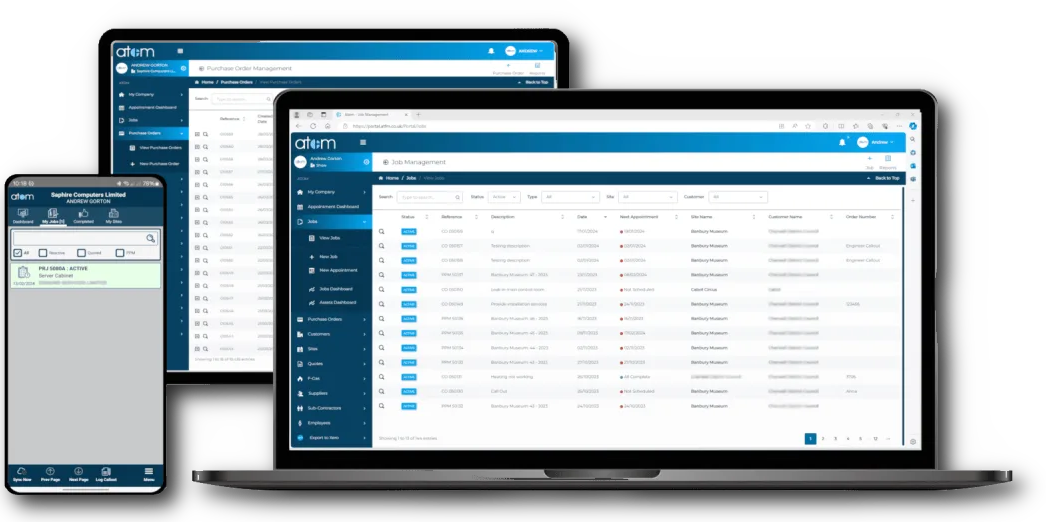
Atom Job Management software provides tools that can help businesses manage PAT testing as part of their wider planned maintenance and job management processes.
Planned Maintenance Creates the Work
Atom’s planned maintenance functionality can be used to set maintenance schedules against assets and establish when recurring work is due.
Rather than relying on someone to remember to check a spreadsheet, scheduled maintenance can generate the required job when the work becomes due.
This helps turn a date in a register into an actual operational task that can be planned and assigned.
PAT Testing Records Can Be Linked to Individual Assets
Keeping track of individual appliances becomes increasingly important as the number of assets grows.
With Atom, asset information and maintenance history can be managed within the system, allowing businesses to maintain a record of work carried out against equipment.
This provides a much clearer history than maintaining a separate list of dates in a spreadsheet.
When someone needs to establish when an appliance was previously tested or what work has been carried out, the information can be accessed as part of the asset’s history.
Manage Multiple Sites and Customers
For businesses carrying out electrical maintenance for multiple customers, PAT testing is rarely the only work being performed.
The same customer may have numerous sites, each containing different assets and different maintenance requirements.
Atom brings customers, sites, assets, jobs and maintenance information together, helping office teams manage the wider relationship rather than treating each PAT test as an isolated task.
This can be particularly useful for facilities management and electrical contractors managing planned and reactive work across a large number of customer sites.
Keep Subcontractor Information Together
Where PAT testing or other maintenance work is completed by subcontractors, Atom’s subcontractor management functionality provides a central place to manage information about those external teams.
Businesses can maintain subcontractor records, track relevant accreditations and insurance information, store documentation and receive reminders when important records are approaching expiry.
This helps businesses manage the subcontractor relationship alongside the work they are carrying out rather than keeping compliance information separately.
Capture Information at the Point of Work
Atom’s mobile functionality allows engineers to access and update job information while working on site.
Electronic forms can be used to capture information required during inspections and maintenance, while photographs and signatures can also be recorded where required.
This reduces the need to rely on handwritten paperwork being returned to the office and manually transferred into another system.
The result is a more immediate record of what has happened on site.
Maintain a Clear Audit Trail
When maintenance, inspections and testing are recorded within the same system, businesses can build a clearer history of the work carried out.
This can make it easier to respond when customers, managers or auditors request information.
Instead of searching through emails, spreadsheets and folders for evidence, staff can access the relevant customer, site, asset and job records from within Atom.
Moving Away From Manual PAT Testing Management
For a small number of appliances, manually tracking PAT testing dates may seem straightforward.
The challenge comes when the number of customers, sites, appliances, engineers and subcontractors increases.
At that point, the business is no longer simply tracking test dates. It is managing a large amount of operational information and needs to ensure that scheduled work is actually created, completed and recorded.
A job management system can help by connecting the different stages of the process.
Testing can be planned against assets, work can be generated and assigned, engineers can record information on site, documentation can be retained and the completed work can become part of the customer’s maintenance history.
This provides a more structured approach than relying on individual spreadsheets and reminders.
How to Stay Ahead of PAT Testing Deadlines
The best time to identify a weakness in a PAT testing process is before a deadline is missed.
Businesses should consider how their current system answers some basic questions:
- How are upcoming PAT testing dates identified?
- Who is responsible for arranging the work?
- What happens when the person responsible is absent?
- How are subcontractor testing records collected?
- Where are certificates and test results stored?
- Can the business quickly identify which appliances are overdue?
- Can staff see the testing history for an individual asset?
- How quickly could the business provide records to a customer or auditor?
- How are completed tests fed back into the maintenance schedule?
If the answer to several of these questions involves searching through spreadsheets, emails or individual files, there may be an opportunity to improve the process.
A centralised system can reduce the amount of manual administration involved and provide greater visibility of upcoming and completed work.
Frequently Asked Questions
Does missing a PAT testing deadline automatically result in a fine?
No. There is no general rule that says an overdue PAT test automatically results in a fine. The legal requirements depend on the circumstances, the equipment and the responsibilities of the business.
However, businesses should have appropriate arrangements for maintaining and inspecting electrical equipment and should retain suitable records where necessary.
Does missing a PAT test invalidate insurance?
Not automatically. Insurance policies differ, and the effect of a missed test will depend on the wording and conditions of the individual policy.
Businesses should speak to their insurer or broker if they are unsure about the requirements that apply to their policy.
Is PAT testing legally required at a fixed interval?
There is no universal legal requirement for every electrical appliance to receive a PAT test at a specific fixed interval.
The appropriate inspection and maintenance arrangements depend on factors such as the equipment, how and where it is used, the environment and the level of risk.
Businesses should ensure that their approach is appropriate to the equipment and circumstances involved.
What should I do if I discover that a PAT test is overdue?
Review the equipment and arrange the appropriate inspection or testing as soon as reasonably possible. Keep a clear record of the original due date and the date the test was actually completed, together with the result and any remedial action required.
Can Atom help manage PAT testing?
Yes. Atom can be used to manage assets, planned maintenance schedules and jobs, helping businesses organise recurring testing and maintenance work.
Atom can also help manage customers and sites, subcontractors, documentation and mobile job information, providing a more connected approach to managing PAT testing alongside other maintenance and service work.
Manage PAT Testing With Atom
Keeping PAT testing on schedule is easier when testing dates, assets, jobs, engineers, subcontractors and customer information are managed within one connected system.
Atom Job Management software helps service, trade and facilities management companies manage planned maintenance, assets, jobs, subcontractors and compliance-related information in one place.
If you want to see how Atom could help your business manage PAT testing and other recurring maintenance requirements, book a demo and see how the system can fit into your existing workflow.